Showing posts with label antique fabric. Show all posts

July 6, 2026

Like a Rolling Stone

Family history tells us that this Rolling Stone quilt may have been made by the owner's great -grandmother.

I'd date most of the quilt top fabrics to the 19-teens to 1920s, with some c. 1900 fabrics included. 


This quilt holds a couple of surprises.  The back and binding fabrics and strips added to the long sides, however, are c. 1940.  This suggests that the top was enlarged a bit and then quilted a while after the top was made.


Another fun tidbit is some older patching.  I always enjoy seeing a quilt that has been mended sometime in the past.  To me, that says that the quilt has always been valued and cared for.  And that seems even sweeter when, like this one, it's still the family of the quilter who made it. 

I found this old patch very amusing!  I patched over the grey-green, leaving the black patch in place.  I chuckled all the while I was sewing it.  It makes me think of entering a tunnel on a drive through the mountains.


This same block gave me some difficulty deciding on a green fabric for the patching.  Nothing was quite right, and as sometimes happens, I had different top choices in daylight vs. lamplight.  I did eventually decide on which would blend in best with the look and feel of the quilt.  


At the other end of the spectrum of finding patching fabrics, matching this blue fabric was a breeze.  There are both old and new patches in this block. 

Here are some of the other fabrics for your enjoyment. 


December 30, 2025

Past Glory

Sometimes a really, really damaged quilt is still incredibly beautiful.  This is one of those times. 

The quilt was sent to me for assessment and my thoughts about what to do with it.  It has much fabric damage, both faded colors and lots of tattered, dangling, and missing fabric.

December 9, 2024

Preserving Our Quilt Legacy - Virtual Workshop


Good news!  My Preserving Our Quilt Legacy Virtual Workshop is coming up soon.  Sessions take place on five Saturdays, Jan 28 - Feb 25 2025.  This is a rare opportunity to learn about the many aspects of restoration and conservation all in one package.  Find out more:

A full description and registration info 

An introductory video

Besides lectures and demos, you’ll receive a set of samples of tools and fabrics, access to video demos of techniques and stitches, links to other resources.  You’ll be able to show a quilt and see everyone else’s quilts and learn about how to assess what each quilt needs and how to proceed.   


Why do I like taking care of quilts?  My academic background is in anthropology, which taught me about how much meaning the objects we make and use every day can hold.  And all quilts have their story.

"Storytelling is the place where social and personal history meet."

This is a line from a lovely book I recently received, How to Write Your Personal or Family History, by Katie Funk Wiebe.  The book was written by the mother of a dear friend of mine.  She wrote many books, many of them about family and history.

One thing she stresses is how small memories and facts can build a valuable memoir.  I feel the same is true of quilts - it's not only the flashy and museum quality quilts that are worth gentle handling and care.

Every quilt cared for and saved preserves a little bit of both family history and our collective history.  It brings to life the history that is not written in textbooks.


November 29, 2023

Virtual Quilt Repair Workshop - Registration is Open!

Taking good care of antique and vintage quilts is taking good care of family, textile, and social history. It’s a wonderful journey! 

My next workshop will be held January 27 - February 24 2024, on 5 consecutive Saturdays.  All the details and registration are on my website.  If you have questions, contact me here or at annquilts@comcast.net. 

Restoration

Conservation

Preservation

Philosophy


Techniques


Supplies 

Each student can present one (or two if time allows) quilts for discussion of how, when, and why to use the various supplies and techniques. All eras and styles are welcome.  This will be our own mini quilt show, with lots of interesting history to discuss!

I have 40 years of experience to share. The workshop is appropriate for quilters, appraisers, collectors, and the keepers of family heirlooms. I'll guess some of you belong to several of those categories at once!


November 18, 2023

Virtual Quilt Repair Workshop - Registration is Open!


Taking good care of antique and vintage quilts is taking good care of family, textile, and social history. It’s a wonderful journey! 

Preserving Our Quilt Legacy Virtual Workshop

My next workshop will be held January 27 - February 24 2024, on 5 consecutive Saturdays.  All the details and registration are on my website


We will cover many aspects of the process.  Restoration, conservation, and preservation.  Finding patching fabrics, which includes gaining knowledge of the history of fabric printing and dyeing.  Learning about needles, threads, and other tools of the trade.  Learning stitches and tips for well-sewn patches.  Learning how to choose what and how much to do, including when to repair and when not to.


Each student can present one (or two if time allows) quilts for discussion of how, when, and why to use the various supplies and techniques. All eras and styles are welcome.  This will be our own mini quilt show, with lots of interesting history to discuss.

I have 40 years of experience to share. The workshop is appropriate for quilters, appraisers, collectors, and the keepers of family heirlooms. I'll guess some of you belong to several of those categories at once!

Please comment here or email me if you have questions!


November 8, 2023

Quilt Repair Tidbits #4

Quilt Repair Tidbits.  The next (somewhat) weekly installment of quilt repair tidbits and photos.

This week’s tidbit:  A hand-me-down set of vintage/antique Mosaic/Grandmother’s Flower Garden blocks.


I’ll be teaching a virtual quilt care and repair workshop in winter 2024.  One thing I’ll be talking about is learning how to tell the age of the fabrics in old quilts.  These blocks have a secret key to their age. 

All the info about the workshop is on my website.  And you can email me to be added to the interest list for notification when registration opens.

So, about the blocks.  The fabrics in the center date to the third quarter of the 1800s.  The outer ring, though, was mysterious.  The print reminds me of a maternity dress I made in 1990, nothing like  the 1860s-70s prints. 

The blocks were English paper pieced, and the outer ring still includes the paper hexagons.  Many of them were cut from a newspaper.  There are papers that give fun glimpses of life at the time those hexies were pieced (my mother adored Maurice Chevalier), and place the blocks, at least the final ring, in Chicago.  Also, notice the tiny and neat whip stitches that join the hexies.


Several of the papers, like this one, refer to events in 1932, which handily dates the curious outer ring.

And the fabrics!  Glorious!  The delicate etching of the prints.  The pairing of tomato soup red with a greyed medium blue.

You can see lots more photos of these blocks on my blog.

So these blocks have had two phases of construction over the course of the last 150 years or so, and still no one has joined them together.  (And I think that the outer print looks still more modern than what newspapers are telling me!)


October 18, 2023

Quilt Repair Tidbits #2

The second installment of weekly quilt repair tidbits and photos.

Schoolhouse quilt, c. 1915-20

This week: a wonderful schoolhouse quilt, a lovely and unusual rendition of a favorite traditional block.  One of the benefits of working with antique and vintage quilts is that it’s like having your own up close and personal quilt show!

I hope I can inspire you to join the virtual quilt repair and care workshop I’m planning for winter 2024.  All the info is on my websiteEmail  me to be added to the mailing list for notification when registration opens.  

The workshop will cover restoration and conservation supplies and techniques and how to choose which to use, and also, fabric history, and preservation concepts like storage and cleaning.  Everyone will get to show a quilt or two and we’ll discuss how to proceed with their care. 


The most damaged block, very ragged fabrics.  I recommended against patching (restoration) and for covering the worn fabrics with fine netting (conservation) to protect them.

This block also has the highest color contrast, which means one color of net doesn’t look equally good on both fabrics.  My assistant Pam and I agreed that patching with two colors of net will look best, light for the sky and building structure, navy for the house shapes.

So you can see why this quilt is such special fun, here’s a quilt with the traditional Schoolhouse block.


July 12, 2023

Caring for Family Mementos

Here comes some thinking and wondering that I've been doing lately.


Over the last few years, people have been asking me to repair soooo many really seriously damaged quilts from the 1960s-70s and onwards.  For the most part, these are family heirlooms, made by beloved grandmas and great-grandmas.  

I'm thinking that what I'm seeing are the quilts that have been used and loved and "used up" in the old-fashioned terminology. 

Many are not fancy in pattern or workwomanship.  Part of this is that in the 1950s-70s era, the making of super intricate quilts kind of drifted off.  I've heard that put to the country's excitement about all sorts of new technological advances, and the exciting prospect of moving into a modern world and leaving the past behind.  Another culprit is the advent of polyester batting which doesn't need nearly as much quilting.  

I've also thought about fabric quality, which I think has been on a decline for several decades.  I think it was in the 1990s or so when people started complaining about being able to see seam allowances through white and pale fabrics, which hadn't been the case before that.  A friend of mine who's been quilting for ages, brought one of the quilts she made in the mid-70s to a show and tell in about 2018.  She told us how she has used it lightly, stored it properly, and all that, and yet the fabrics are just pulling apart along the quilting lines...while sitting quietly in storage.  And this was name brand fabric, not a thinner, discount store knock-off. 

It's lovely to have people wanting to have the everyday kind of quilt to be saved.  Quilt historians of today certainly would love to have more of those from previous centuries (not just the "best" quilts, in other words) - but the time to save them is before they are really damaged. 

These fabrics get thin before they tear.  That means that one more wash can end up making massive damage, all at once. 

The cautionary tale here is that the time to start caring for family quilts is before you see the damage, not after.  Fabrics are not as sturdy as furniture or paintings or china.  Clothes that are worn and washed don't last past a handful or two of years.  And quilts are made of the same kinds of fabrics as our clothing.  Heirloom clothes like wedding dresses get special treatment, so should heirloom quilts.
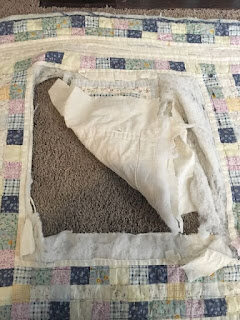

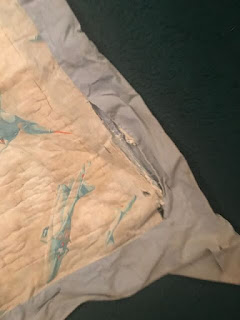
I like to say that I can repair just about any quilt, given enough time and money.  And I have repaired things that have come to me looking like a pile of rags.  I'm happy to do so, because I value the family memories, too.  But the other side of that coin is that the more work I do, the less it is the quilt that the ancestor made and the more it has a lot of me in it, too.

I have developed a way to support very tattered quilts.  This neatens up the appearance and makes it safer to handle the quilt, but doesn’t actually repair the damage.  This can still cost several hundreds of dollars.  Some folks opt to have me do this to maintain the heirloom, and then also find someone to make a replica that can join the family and be displayed or used.  This is basically having the best of both worlds.

Certainly, loving use is often what quilts were made for initially.  But once the thought of saving one as an heirloom crosses your mind, that's the time to think about conservation, proper storage, and removal from use.

It's a personal choice of course, but I believe it should be a conscious choice between use and passing to the next generations.  Sometimes, it's really not feasible to do both.

What's your opinion?


May 8, 2023

Taking Care of a Crazy Quilt....by not Restoring It


The owner sent me these photos of her gorgeous crazy quilt for an initial assessment.  She and I decided not to do any repairs at this time.  However, it's such a beautiful quilt that I wanted to share it, and I am grateful that she has allowed me to share her photos.

It was made for my great great grandfather John Davis Cassada when he was born by his mother Lucy and his aunts.  Many were single or widowed from the Civil War.  All the initials are attributable to family members.  They were very thrilled to have a male in the family and used many 'fancy' scraps of silk and velvet. 

 John Davis Cassada was born in 1874.  His mother's name was spelled Lucie and Lucy alternatively.   John was born in South Boston, Virginia.  His family moved and he married and settled in Halifax then Raleigh area North Carolina. 

The reason I didn't have her send the quilt to me for repair is that the damage, shattering silk, is minimal for a silk quilt of this era.  Shattering is the damage caused by metal salts that were sometimes added during the manufacturing of silks during the Victorian era.

AddThis